Tűzkereszt means “Fire Cross”, a Hungarian military decoration awarded for front-line combat service between 1941 and 1943.
Hungarian Military History Archive
An online archive preserving Hungarian and Austro-Hungarian military history through original photographs, awards, documents, and research material.
2017-07-22
2017-04-20
" Three moments from Home "
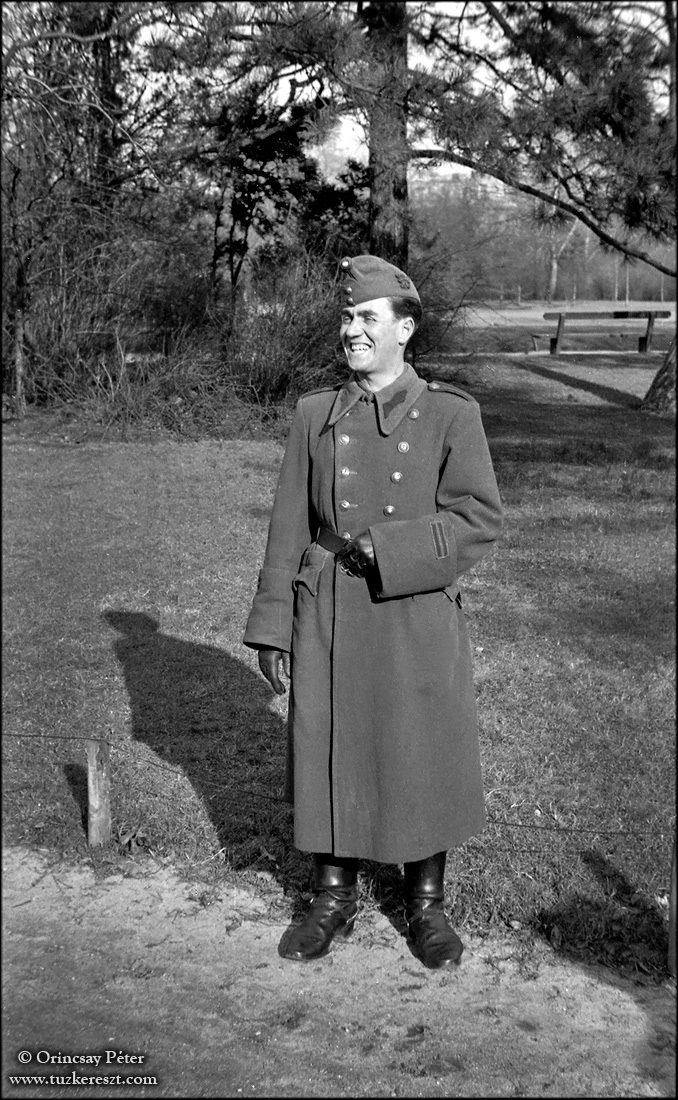
Among a recent purchase of various Hungarian military photographs, I noticed these three images among a larger group of related photographs. Unfortunately, no names, dates, or identifying information could be found. The location could have been almost anywhere in the Hungarian countryside more than 70 years ago.
Although the identity of the Hungarian Honvéd soldier remains unknown, these three photographs are nevertheless valuable historical documents and fascinating glimpses into a bygone era.
2017-03-18
2016-12-29
" Huszár "
A proud Hungarian cavalry private (Huszár) poses in the traditional manner beside his horse, embodying the spirit and heritage of Hungary’s famed cavalry arm. The Hussars were among the most iconic soldiers in Hungarian military history, renowned for their horsemanship, discipline, and distinctive martial traditions.
Although warfare had become increasingly mechanized by the twentieth century, cavalry units continued to play an important role in the Royal Hungarian Army, particularly in reconnaissance, security duties, and mobile operations. The close bond between horse and rider remained a defining characteristic of the Hussar service, and photographs such as this reflect the pride soldiers took in both their mounts and their regiment.
The image captures a timeless military tradition, preserving the elegance and esprit de corps of the Hungarian Hussar in the age of modern warfare.
2016-10-30
" Eger Castle "
Military horses fill the inner courtyard of the historic castle at Eger. Originally founded in the 11th century, the fortress is one of Hungary's most famous strongholds and has played a significant role in the nation's military history for centuries.
The castle remained in military use well into the twentieth century, serving various functions until the Second World War. Photographs such as this illustrate the continued connection between Hungary's historic fortifications and its modern armed forces, with cavalry and transport horses still forming an important part of military operations during the interwar period and the early years of the war.
Best known for its heroic defense against the Ottoman siege of 1552, the Castle of Eger remained a symbol of Hungarian resilience and military tradition long after its strategic importance had diminished.
This image presents a striking contrast between medieval walls and the military requirements of the modern age, as horses crowd the courtyard of one of Hungary's most iconic fortresses.
Today, the Castle of Eger no longer serves a military function. Instead, it has been transformed into one of Hungary's most important historical and cultural sites, housing a variety of fascinating exhibitions, museums, and collections dedicated to the castle's long and eventful past.
Visitors can explore centuries of Hungarian history within the very walls where many of these events unfolded. Families regularly bring their children to the castle to learn about the nation's heritage, military traditions, and the famous siege of 1552, experiencing history in the same environment where it was made.
The contrast between past and present is striking: a place once filled with soldiers, horses, and military activity has become a center for education, preservation, and remembrance, ensuring that the stories of earlier generations remain alive for future visitors.
Today, the Castle of Eger stands not as a fortress of war, but as a living monument to Hungary's rich historical legacy.
2016-09-13
" Five in a row "
Group photographs could take many forms, ranging from formal studio portraits to informal snapshots among comrades. This image shows five Hungarian cavalry privates posing together, most of them dressed in light summer shirts, while the soldier on the far right wears a summer tunic.
A distinctive feature identifying their branch of service is the characteristic cavalry boot, whose slightly V-shaped upper edge was typical of mounted troops. Such details often allow military historians to distinguish cavalrymen from soldiers of other branches, even when insignia are not clearly visible.
The lighter summer clothing reflects the practical adaptations made for warmer weather, while the relaxed pose of the men suggests this was a personal photograph rather than an official military image.
The photograph captures a group of young cavalrymen in a moment of camaraderie, preserving both the uniforms and traditions of Hungary's mounted arm during the interwar or wartime period.
2016-07-25
" In Full Control "
Horsemanship was an essential part of every officer's education at the Royal Hungarian Army's military academies. Although riding was not always a regular requirement in an officer's later career, it remained an important element of military training, reflecting both practical needs and centuries of Hungarian military tradition.
Even during the Second World War, when mechanised units increasingly dominated modern warfare, the Royal Hungarian Army continued to rely heavily on horses for transportation, logistics, artillery, and cavalry operations. On the Eastern Front in particular, horses often proved indispensable. During the harsh winter months, motor vehicles frequently became inoperable due to extreme cold, poor road conditions, fuel shortages, or enemy action. Under such circumstances, horse-drawn transport remained a dependable means of moving men, supplies, and equipment, and undoubtedly contributed to the survival of many soldiers.
This photograph reflects the enduring importance of the horse in the Royal Hungarian Army—a tradition that combined centuries of military heritage with the practical realities of twentieth-century warfare.
2016-07-19
" Mechanised Cavalry "
A fine series of portrait photographs, scanned from the original negative, depicting a Hungarian cavalry private serving with a mechanized unit. The quality of the original negative preserves an exceptional level of detail, offering a clear view of both the soldier and his surroundings.
Visible in the background is a Hungarian-built Rába 38M "Botond" all-terrain truck, one of the Royal Hungarian Army's most successful military vehicles. Renowned for its rugged construction and excellent cross-country performance, the Botond was widely employed for transporting troops, supplies, and equipment on both roads and difficult terrain throughout the Second World War.
These portraits capture the transition of Hungary's cavalry arm into the age of mechanization, where traditional mounted troops increasingly served alongside modern military vehicles while preserving the proud heritage of the Hungarian cavalry.
2016-06-18
" Huszár "
A Hungarian cavalry private wearing the 1930-pattern uniform of the Royal Hungarian Army. The uniform reflects the distinctive traditions of Hungary's mounted arm, preserving many features that had characterized Hungarian cavalry for generations while incorporating practical refinements introduced during the interwar period.
Throughout the 1930s, cavalrymen continued to play an important role in the Royal Hungarian Army, serving in reconnaissance, security, and mobile operations. Although military forces across Europe were becoming increasingly mechanized, the Hungarian cavalry retained its value through its mobility, horsemanship, and ability to operate in terrain where motor vehicles were often less effective.
This portrait offers an excellent view of the 1930-pattern cavalry uniform, illustrating the appearance and traditions of Hungary's mounted soldiers during the interwar years.
.2016-01-25
" Krupp-Protze "
German and Hungarian soldiers pose together beside a German-built Krupp-Protze, a six-wheeled 6×4 artillery truck widely used during the Second World War. Renowned for its reliability and excellent cross-country performance, the Krupp-Protze served as a prime mover for artillery, as well as a transport vehicle for troops, ammunition, and equipment.
Mounted on the front of the vehicle is a sign reading "Caution Convoy," identifying it as part of a Hungarian Army convoy. Such signs were commonly displayed to assist with traffic control and convoy organization during military movements.
Although the exact location is unknown, the photograph was most likely taken somewhere on the Eastern Front, where German and Hungarian forces frequently operated alongside one another during the campaigns in the Soviet Union. Images such as this illustrate the close operational cooperation between the two armies and preserve a moment of comradeship amid the demands of wartime service.
This photograph offers a fine glimpse of Allied Axis cooperation on the Eastern Front, with Hungarian and German soldiers gathered around one of the most recognizable military transport vehicles of the period—the Krupp-Protze.
2015-12-16
2015-12-03
Cavalry private
A Hungarian cavalry private wearing the 1930-pattern uniform of the Royal Hungarian Army. The uniform reflects the long-standing traditions of Hungary's mounted arm, combining practical military dress with distinctive features that had characterized Hungarian cavalry for generations.
During the interwar period, the cavalry remained an important component of the Royal Hungarian Army. Although mechanization was steadily transforming modern warfare, mounted troops continued to serve in reconnaissance, security, courier, and mobile operations, where their mobility and adaptability often proved invaluable.
The soldier's uniform and equipment illustrate the appearance of a Hungarian cavalryman during the 1930s, a period in which traditional horsemanship and modern military doctrine existed side by side.
This portrait preserves the image of a young cavalry private, representing one of the last generations of Hungarian mounted soldiers before mechanization became the dominant force on the battlefield.
2015-10-28
The Blacksmith and the Horses
Throughout the Second World War, the Royal Hungarian Army remained heavily dependent on horses for transportation, logistics, artillery, and cavalry operations. While mechanization was steadily transforming modern warfare, horses continued to play an indispensable role, particularly in difficult terrain and under conditions where motor vehicles could not operate effectively.
The soldiers responsible for the care of these animals possessed considerable knowledge and experience, many having served with horse-drawn units during the First World War. Their expertise in handling, feeding, and maintaining horses was essential to the army's mobility and operational effectiveness.
Among these specialists, the military blacksmith occupied a particularly important position. Responsible for shoeing horses and maintaining their hoof health, the blacksmith ensured that animals remained fit for the demanding conditions of military service. His skills were highly valued, for without healthy horses, the movement of troops, artillery, and supplies could quickly come to a standstill.
This photograph pays tribute to the often-overlooked craftsmen and horse handlers whose knowledge and dedication helped keep the Royal Hungarian Army moving throughout the war.
2015-09-20
Light mechanized infantry
Hungarian light mechanized infantry operating in the Carpathian Mountains during the opening phase of the campaign against the Soviet Union. This photograph was taken sometime in the late summer of 1941, when Hungarian forces were advancing through the rugged mountain terrain following the beginning of operations on the Eastern Front.
The light mechanized infantry combined the mobility of motorized transport with the fighting capability of traditional infantry, allowing units to move rapidly over long distances while remaining capable of operating on foot when required. In the mountainous regions of the Carpathians, however, difficult roads and steep terrain often limited the effectiveness of vehicles, requiring soldiers to adapt to demanding conditions.
This photograph captures the early optimism of the 1941 campaign, preserving a moment from the opening months of Hungary's participation in the war against the Soviet Union before the conflict developed into a prolonged and costly struggle.
2015-05-13
The Painted Uniform
From time to time, I come across beautifully hand-colored photographs produced around the same period as the original image. They are not always historically accurate in every detail, but they often show considerable skill, imagination, and artistic charm.
This photograph is a perfect example. The artist appears to have tried to transform a 1930-pattern Hungarian uniform into something resembling a colorful First World War Hussar parade uniform, adding bright colors and elaborate decorative details directly over the original photograph. However, the breast pockets of the 1930-style tunic remain clearly visible beneath the painted embellishments, revealing the true nature of the uniform underneath.
The result is both interesting and amusing—a charming period piece that reflects not only military fashion and memory, but also the creativity and fantasy sometimes applied by photographers and colorists when turning black-and-white portraits into colorful keepsakes.
2015-03-26
The Cavalry Lance Corporal
A beautifully sharp portrait of a Hungarian lance corporal, preserved on its original glass negative. The image comes from the surviving collection of a professional studio photographer and has been scanned in its full size, without any cropping, allowing the original negative to be appreciated exactly as it has survived.
Glass plate negatives were the standard medium for professional photographers during the late nineteenth and early twentieth centuries. Because they were relatively expensive, many photographers reused them after the customer had received the finished prints. Occasionally, however, a negative was retained so that additional copies could be produced in the future, and it is thanks to this practice that portraits such as this have survived.
The dark borders visible around the image were never intended to appear in the finished photograph. During printing, the photographer cropped the negative to create the final composition. Any retouching was carried out directly on the glass negative itself while it was being processed, which explains the clear central area and the markings visible outside the intended print area.
This photograph is one of several surviving glass negatives from the same studio collection. They offer a fascinating insight into both Hungarian military portraiture and the photographic techniques of the period. More images from this remarkable heritage will be published here on the website in the future.
2014-12-24
The last Christmas on the Don front
A haunting photograph from the personal album of the commander of the 22nd Hussar Regiment, taken in the small Russian village of Karpenkovo near the Don River during Christmas 1942. Surrounded by his soldiers, the commander shares a quiet moment with his men far from home, as the festive season passes amidst the harsh realities of the Eastern Front.
The expressions on the soldiers' faces seem to betray their thoughts. It is easy to imagine them thinking of their families, friends, and homes in Hungary rather than the frozen landscape that surrounded them. Whether they were hopeful, anxious, or simply exhausted, the photograph captures a deeply human moment that transcends the military setting.
Unbeknown to the men gathered for this Christmas photograph, the Hungarian Second Army stood on the eve of disaster. Less than three weeks later, on 12 January 1943, the Soviet Voronezh Front launched its massive offensive along the Don River. The ensuing battles shattered the Hungarian defensive line, leading to the destruction of much of the Second Army and one of the greatest tragedies in Hungary's military history.
Viewed with the knowledge of what was soon to come, this photograph becomes especially poignant. It preserves a final moment of calm before the storm—a gathering of comrades whose future, unknown to them at the time, would soon be irrevocably changed by the events of January 1943.
Brothers in arms, gather for a moment of silence and Christmas spirit.
2014-03-09
Hungarian cavalry in the summer of 1942
Hungarian cavalrymen pause for a well-earned rest beside a dusty country road somewhere in Russia during the summer of 1942. Amid the long marches and demanding conditions of the Eastern Front, brief moments such as this offered both the soldiers and their horses a welcome opportunity to recover before continuing their journey.
Although the Second World War is often associated with tanks and mechanized warfare, horses remained indispensable to the Royal Hungarian Army. Cavalry units, together with horse-drawn transport, played a vital role in reconnaissance, communications, supply, and the movement of artillery across terrain where motor vehicles frequently struggled.
The photograph captures not combat, but the quieter reality of military life on campaign. The soldiers rest in the shade while their horses stand patiently nearby, illustrating the close relationship between cavalrymen and the animals upon which they depended throughout the campaign.
More than eighty years later, this simple roadside scene serves as a reminder that the history of war was shaped not only by battles, but also by the countless pauses along the way—moments of rest, companionship, and quiet endurance before the march resumed.