Tűzkereszt means “Fire Cross”, a Hungarian military decoration awarded for front-line combat service between 1941 and 1943.

Hungarian Military History Archive

An online archive preserving Hungarian and Austro-Hungarian military history through original photographs, awards, documents, and research material.

ESTABLISHED 2010
Showing posts with label Tűzharcos Szövetség. Show all posts

2017-04-24

" Serving my Country "

WW1-veteran, Hungarian staff sergeant with an impressive medal bar.

 I. class Silver medal for bravery
II. class Silver medal for bravery with 2-nd award clasp
Bronze medal for bravery
Carl Troop Cross for front line service


2017-03-17

" My fellow Tűzharcosok! "

A leader of the Tűzharcos Szövetség (National Front-Line Fighters’ Association) addresses a crowd gathered outside his home from the balcony above. This fine early-1920s photograph comes from a larger series preserved within the heritage of the Tűzharcos Szövetség.

The image captures a moment of public engagement and camaraderie among veterans in the years following the First World War, reflecting the important social and commemorative role played by the association during the interwar period.

2016-05-18

Tűzharcos 

(National Front-Line Fighters’ Association) collage.

2016-04-21

The Frontharcos Flag

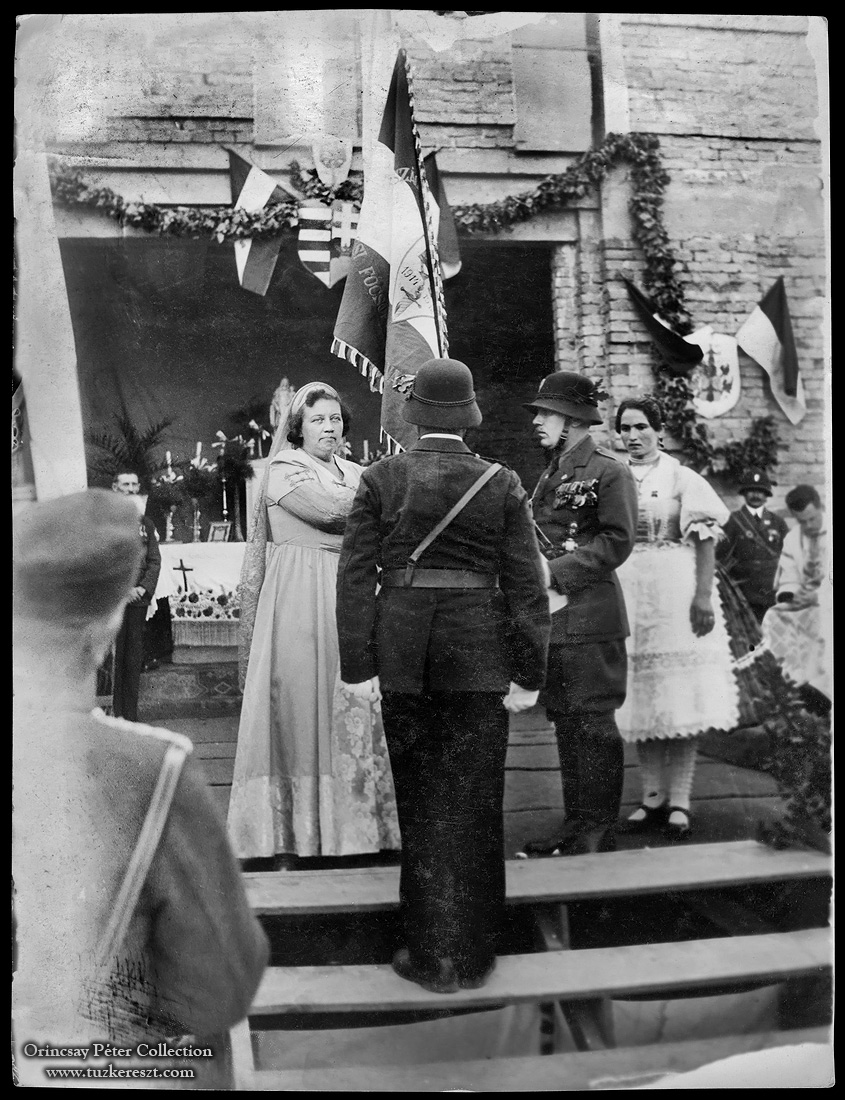
 In the Southern Hungarian town of Mohács, people are gathering on the square for the Frontharcos (National Front-Line Fighters’ Association) Flag ceremony.

Mr Lajos Schmidt, Hungarian member of parliament and local from Mohács arrives together with his wife "The flag mother".

 Captain Lajos Schmidt, a veteran from WW1 and a member of Frontharcos (National Front-Line Fighters’ Association) played a key role in the Hungarian resistance during the Yugoslav occupation of Mohács that ended in 1921 when the town returned to Hungary.

The flag is given its embroiled ribbon with the words given by the "The flag mother", Mrs Schmidt.

 The Frontharcos members with their flag.

The gathering after the ceremony for the Frontharcos flag in Mohács.

2013-04-13

German railway employees in Budapest

German railway employees and First World War veterans visit Budapest in 1935, paying their respects at the Great War memorial in Hősök tere (Heroes' Square). The photograph captures a commemorative gathering that brought together former servicemen to honor the memory of those who never returned from the battlefields of 1914–1918.

During the interwar years, veterans' organizations and professional associations frequently organized journeys to important memorials and historic sites across Europe. For many participants, these visits were an opportunity to remember fallen comrades, renew old friendships, and reflect upon the shared experiences of the Great War.

Heroes' Square was one of Hungary's most important places of national remembrance, and ceremonies held there often attracted both Hungarian and foreign visitors. The presence of German railway employees—many of whom were themselves veterans—highlights the enduring bonds that existed between former soldiers and the common desire to commemorate the sacrifices of the First World War.

More than ninety years later, this photograph remains a poignant reminder that remembrance extended beyond national borders. It preserves a moment when veterans gathered not to celebrate war, but to honor the memory of those whose lives had been forever shaped—or ended—by it.

2013-03-14

Veteran from World War I 

Portrait of a member of the Tűzharcos Szövetség (National Front-Line Fighters' Association). Founded in the interwar period, the organization brought together Hungarian veterans who had served under enemy fire, preserving the camaraderie, traditions, and memories of front-line service.

Membership in the Tűzharcos Szövetség was reserved for veterans who had experienced combat, making it one of Hungary's most distinguished ex-servicemen's organizations. Beyond fostering fellowship among former soldiers, the association organized commemorative events, supported veterans and their families, and worked to preserve the legacy of those who had served the nation in wartime.

Portraits such as this were often commissioned with great pride, reflecting not only military service but also the continued bond that many veterans maintained with their comrades long after returning to civilian life. The association's insignia served as a visible symbol of shared sacrifice and front-line experience.

Although the identity of this veteran has been lost to history, his portrait remains a lasting tribute to one of the many men whose wartime service continued to shape their lives long after the guns had fallen silent. Today, it stands as a valuable reminder of Hungary's veteran tradition during the interwar years.

2012-10-24

The breast badge of HONSz. 

Badge of the Hadirokkantak, Hadiözvegyek és Hadiárvák Országos Nemzeti Szövetsége (HONSz) – the National Association for War Disabled, War Widows and War Orphans. Founded in the aftermath of the First World War, the organization provided support and representation for those whose lives had been profoundly affected by the conflict.

HONSz worked to assist disabled veterans, the widows of fallen servicemen, and children who had lost one or both parents during wartime. In addition to advocating for their welfare and social rights, the association helped preserve the memory of those who had sacrificed their lives in military service.

Throughout the 1930s and during the Second World War, HONSz remained one of Hungary's principal veterans' and welfare organizations. Its membership badges identified those associated with the organization and symbolized solidarity with the thousands of families who continued to bear the lasting consequences of war.

Today, badges of HONSz are important historical artifacts, representing not only a veterans' organization but also the enduring commitment to care for those left behind by war. They stand as reminders that the impact of conflict extended far beyond the battlefield, affecting veterans, widows, and orphans for generations.

2012-04-12

Andrássy út

A few weeks ago, while walking along Andrássy Avenue (Andrássy út) in Budapest, I passed the impressive headquarters of the Hungarian State Railways (Magyar Államvasutak, or MÁV). Mounted prominently on the corner of the historic building is a striking memorial dedicated to the railway employees who lost their lives during the First World War. As I walked by, I stopped to photograph the monument for the Tűzkereszt blog and spent a few quiet moments reflecting on its history and the powerful symbolism of its sculptural figures.

The railway network played a vital role during the Great War, transporting troops, equipment, ammunition, and supplies across the Austro-Hungarian Monarchy. Thousands of railway employees served both on the home front and near the front lines, where many paid the ultimate sacrifice while carrying out duties essential to the war effort. After the war, memorials such as this were erected to commemorate their service and preserve the memory of colleagues who never returned.

The monument's dramatic sculptures convey both grief and dignity, serving as a poignant reminder that the burden of war extended far beyond the battlefield. It stands not only as a tribute to fallen railway workers but also as a testament to the indispensable role that civilian professions played in sustaining a nation at war.

Budapest is rich in monuments that quietly tell the stories of Hungary's military past, and this memorial is one of the city's lesser-known treasures. Pausing before it offered a moment to remember the men whose names are carved into the stone, ensuring that their service continues to be remembered more than a century after the end of the Great War.


2012-04-05

 The memorial

During a recent visit to Hungary, I stopped at the First World War memorial in the historic town of Sárospatak, located in the Borsod-Abaúj-Zemplén County of northeastern Hungary. It was a beautiful spring day, and I took the opportunity to photograph the monument with my mobile phone for the Tűzkereszt blog.

Like many Hungarian towns and villages, Sárospatak erected a memorial to honor the local men who never returned from the battlefields of the Great War. These monuments became places of remembrance for families and communities, preserving the names of those who made the ultimate sacrifice and ensuring that their service would not be forgotten.

More than a century after the end of the First World War, such memorials continue to play an important role in Hungary's historical landscape. They remind visitors that behind every engraved name was an individual with a family, a hometown, and a life forever interrupted by war.

Whenever I travel through Hungary, I make time to visit these monuments. Each one tells the story of a different community, yet together they form a lasting tribute to the generation whose sacrifice shaped the nation's history. Recording and sharing them through the Tűzkereszt blog is my small contribution to preserving their memory.


The 1914 - 1918 fallen sons of Sárospatak.